Showing posts with label darkroomlayout. Show all posts

types of darkroom

Entry Type / Darkroom Door

The darkroom is an important location in the radiology department where the x-ray film taken is processed. This room lacks illumination compared to normal rooms. The purpose of keeping dark in this room is to process photosensitive photographic materials.

Entrance

The door of this room is light tight, that is, it is made in such a way that rays of light could not enter it. The door has a locking system so that other people do not enter the room during film processing.

There are four types of darkroom depending on entrance / entry.

1. revolving door

It is the most expensive type of the most efficient type of door. It is made up of two cylinders. The outer cylinder is fixed and the inner part is a curved door with only one opening.

revolving door


2. Single door

 This is the most simple and inexpensive type of door. Due to this door's left descent being open, light rays directly enter the dark room. In this type of round system, locking mechanism is used. When the film bin is open in the darkroom or the film is being processed, the door remains locked / closed.

Single door


3. Double door system

 This type of dark room has two doors, one door opens to the outside and one opens inward. There is a hallway between the two doors. In this pattern, one door opens only when the other door is closed.

Double door system


4. Maze type door

 In this type of entrance, there is no door, a labyrinth like a labyrinth leads to Darkroom, for this more space is required, it is also called labyrinth entrance.

Maze type door


Darkroom illumination

Darkroom illumination

Darkroom I should have three types of illumination

1. Safe light 

2. Normal light

3.radiographic illumination

1.safe light

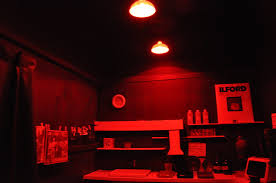
Safe light is a special light used to illuminate or illuminate the dark room, which does not affect the X-ray film. This light source provides the light of safe wavelength so that it can work in the dark room as well. Loading of other types of radiographic film in X-ray film also does not affect the process of developing and storing green yellow brown light as safe light in dark room. Safe light or safe light is also used as dark room light. it is said.
This light can also work in the dark room and film fogging will not be produced. There should be a distance of at least 1.2 meters between the safe light and the film.

Safe light specifications

Safe light lamps have hight 201mm, width 315mm and depth 167mm. 220-230V power supply is required for this. Its bulb is 8-9 watts. A filter is used in front of this light to reduce the wavelength of the light.

Safe light check

The safe light should be checked periodically. It takes an unexposed x ray film to check for safe light. And let's put a metal coin on this film. Keep in mind that the restroom should be all light off. And safe light should be on. Keep the coin on the film for some time. After this, we process the film. As shown in the picture, if the coin image is made on the film, it means that the safe light is improper, that is not correct. If the coin image is not made on the film, then the safe light is absolutely fine.
darkroom illumination

Do not expose the following types of films in safe light:
Panchromatic black and white film
Duplicating film
High speed infra red film

Types of safe light 

A. Direct safe light
B. Indirect safe ligh

A. Direct safe light
Light is applied directly to the work surface. A distance of at least 4 feet from the working surface is required. This film is suitable for loading and unloading.
B. Indirect safe light
It is used for general illumination of darkroom. In this, the direction of light is kept towards the ceiling.

2. Normal light

Normal light means a 100 watt bulb is used. It is a normal light commonly used in homes. And it is used to replace normal work such as cleaning solution and solution.

3. Radiographic illumination 

A fluoroscent illumination must be arranged above the washing compatment to see the wet film so that the solution cannot be mixed with each other.

darkroom in radiology

 x-ray darkroom

introduction

xray film is very sensitive to light and radiation. So these xray films are processed in a darkened room [darkroom]. The reason for poor xray is the wrong technique adopted in the darkroom and not the bad exposure or radiograph technique.

pass box


position of darkroom

To reduce the time taken for expose and unexpose xray films to be moved between the radiography room and the darkroom, the darkroom should be located in the center of the radiology department. Should be the same.

size and developement

The darkroom should be very large and the land should be 100 square feet and height 11. So that all equipment can be kept without crowding. The loading batch and processing tank are the main ones in these devices. Which is called the wet and dry side of the darkroom. And it is very important to have a proper distance between them. Therefore, loading batches and processing tanks should be in opposite corners of the darkroom.

darkroom layout

The following requirements are required for the construction of a dark room to perform quality work in a protective manner.

1.radiation protection

To prevent radiation, the walls of the dark room should be made of 9 inch thick concrete or the walls of the dark room should be covered with a layer of lead which should be 1.5 mm in thickness. Being in close proximity to the radiography room, it is very important for the dark room to be protected from radiation.

2. floor

The floor of the dark room should be easily cleaned so that the spots of the developer fixer should not be frozen on the floor, ie, protected from the effects of chemicals. Also the floor / floor should not be slippery, so the ceramic tiles should be used for flooring in the darkroom.

3 .wall (dark room wall)

The walls of the dark room do not have to be black in color, but choose the color given that it can reflect the maximum amount of safe light. Also, there should be an anti-chemical layer on the walls of the dark room so that the chemical does not have any effect on the wall. . Like -Varnish

4.vantilation of darkroom

Do not normally install windows in the dark room because this brings the light inside the dark room, so you can use ac for ventilation and can also install fans.

5. electrical wire

 The dark room floor is sometimes wet due to the developer fixer and water etc. in the dark room. The radiographer's hands are also wet during the work, which is likely to cause a current, so the electrical wires must be safely under-ground so that the radiographer is least likely to be electrocuted.

6. door (dark room door)

The door of the dark room should be in such a way that light cannot enter the dark room and the door should be arranged in such a way that it can be closed only from inside otherwise the staff will open the door of the dark room repeatedly from outside. But there is a possibility of reaching light and radiation in the dark room. Nowadays interest revolving doors are used maximum in the dark room, it occupies very less space and is more secure from the point of view of radiation and light.

7. pass box

The pass box in the darkroom is the location whereby the exposure cassette from the radiographic room is sent to the dark room and the unexpose films from the dark room are transported to the radiographic room. The passbox should be near the loading batch so that the working radiographer Do not be too much discomfort.

The pass box consists of two doors made of lead metal, in which one part contains expose films and the other part consists of un-exposed films. Due to the wall ledge of the pass box, its doors are light and radiation resistant and these doors are arranged in such a way that both cannot be opened simultaneously. They have an interlock system. If both the doors are opened at one time, then there is a possibility of lighting and radiation on the films.

Darkrook occupies a very important position in the radiology department. After exposure of xray films in the radiology department, the manual processing is done in a dark room called a darkroom. In the darkroom, there is a safe light to work rather than complete darkness. After xray exposure, darkroom is required to convert the latent image of exposure films into a visible image.